NITI Aayog’s Frontier Tech Hub report (July 2026) on Bio Economy should be read by institutional allocators as an industry roadmap, not a policy press release. The target is ambitious: scale India’s bioeconomy from $195.3 billion in 2025 (4.8% of GDP) to $691 billion by 2035, and $2.6 trillion by 2047 (8–10% of an envisaged $30-trillion economy). That represents a near-3.5x expansion over the next decade.

The structural thesis is far narrower and more lucrative: capital and operating margins are migrating aggressively toward biologics, synthetic-biology platforms, and contract manufacturing (CDMO/CRO) infrastructure—not toward the commodity Bio Industrial volume plays that will generate the largest headline revenue.
Must Read: Q1 Earnings: Riding the Wave of Reflation
Key Ecosystem Indicators
- Startup Density: 10,000+ biotech startups active today (up from just 50 a decade ago).
- USFDA Infrastructure: 700+ USFDA-approved plants—the highest density of compliant manufacturing assets outside the United States.
- Global Footprint: 20+ biosimilars already commercialized in regulated international markets.
- Capital Catalyst: A proposed ₹50,000-crore ($5.8 billion) BioEconomy Growth Fund (2026–2035) to be anchored inside the government’s flagship ₹1-lakh-crore RDI Scheme.
- Macro Tailwinds: Global bioeconomy expanding from $4 trillion (2025) to $30–$32 trillion by 2050 (~13% of global GDP).
Where the Margin Actually Sits
On paper, BioIndustrial (biofuels, bioplastics, biopolymers, industrial enzymes) dominates total dollar value across every horizon, projected to reach $318 billion by 2035. However, this segment is governed by commodity economics—high volumes, thin operating margins, heavy feedstock exposure, and dependence on government mandates like the E20 ethanol cycle. It builds the headline topline, but it will not drive institutional alpha.
The true value-capture trade sits squarely in BioPharma, specifically biosimilars and next-generation biologics. Biosimilars are compounding at a 17% CAGR with near-10x ROI, while conventional small-molecule generics stagnate at 2% growth.
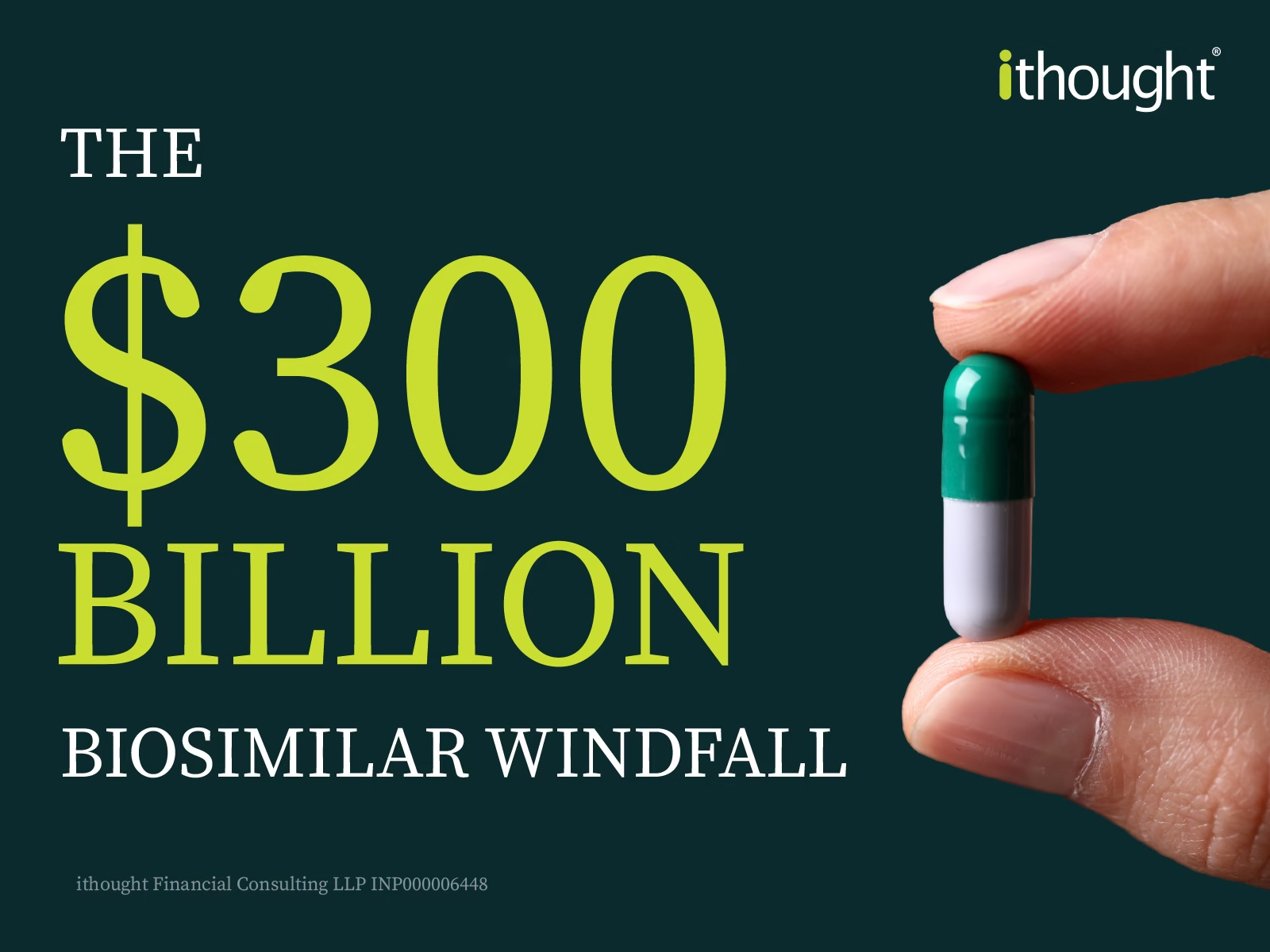
The $300-Billion TAM: By 2035, biologics will account for 40% of global medicine sales. Crucially, ~$300 billion in blockbuster biopharmaceuticals will lose patent protection by 2030. Capturing even a modest share of the global biosimilar opportunity by 2030 yields high-margin annual revenue for Indian biopharma.
Backed by the ₹10,000-crore Biopharma SHAKTI program, a planned network of 1,000+ accredited clinical-trial sites, and the synthetic-biology BioX Foundry ecosystem, the direction of institutional capital is clear: scaled CDMO/CRO players and specialized biopharma asset-owners sit closest to the economic profit pool.
Capturing the 10x ROI inherent to biosimilars requires a distinct set of operational moats: large-scale mammalian and microbial bioreactor capacity, advanced bio-analytical infrastructure, USFDA compliance across commercial plants, and the balance sheet strength to fund multi-million dollar Phase-III clinical trials.
In the Indian equity universe, companies positioned to monetize the $300 billion global patent cliff by 2030 fall into two primary categories: Integrated Biosimilar Asset Owners and Biologics CDMO/CRO Platforms.
Integrated Biosimilar Asset Owners are players own the intellectual property and commercial rights to biosimilar molecules, taking on clinical development risk in exchange for massive top-line expansion and high gross margins (60%–75%). Biocon Biologics is the market leader in Indian biosimilars. Following its full acquisition of Viatris’ global biosimilars business, Biocon commands an integrated front-end commercial infrastructure across the US and Europe. Its portfolio focuses on high-value insulins (Glargine) and monoclonal antibodies (Trastuzumab, Pegfilgrastim, Bevacizumab), allowing it to directly capture end-market commercial value.
Biologics & Synthetic Biology CDMO/CRO Platforms:
These companies avoid drug-failure risk altogether. Instead, they operate as high-margin “pick-and-shovel” providers, offering development and biomanufacturing services to global biopharma firms seeking to de-risk supply chains outside China.
- Syngene International: India’s premier pure-play CRO/CDMO. Syngene has expanded its commercial-scale mammalian bioreactor capacity (including 20,000L+ plant footprints) and bio-analytical testing suites. It benefits directly from long-term, sticky contracts with global Big Pharma, yielding predictable, high-margin fee-for-service cash flows.
- Enzene Biosciences (Subsidiary of Alkem Laboratories): A technology disruptor utilizing proprietary continuous biomanufacturing platforms (EnzeneX™). By reducing the physical footprint and capital cost of bioreactor suites, Enzene delivers biologics at a fraction of traditional CAPEX/OPEX, making it an attractive partner for global drug developers.
Key Catalysts to Track
- Fund Notification: Cabinet approval and operationalization of the ₹50,000-crore BioEconomy Growth Fund under the RDI Scheme.
- Regulatory Reform Motion: Legislative enablement of the Regulatory Sandbox and CDSCO modernization (targeting the 500-day approval benchmark).
- Fiscal Allocations: Budgetary disbursements for the ₹10,000-crore Biopharma SHAKTI initiative and physical break-ground on the five Bioinnovation Clusters.
The bioeconomy thesis is real, but it is not undifferentiated. The capital-efficient trade lies in biologics, biosimilars, CDMO capacity, and synthetic-biology platforms positioning for the 2030 patent cliff—not in the commodity BioIndustrial volumes that will dominate the headline dollar figures.

Data Source & Reference: Roadmap for Building India as a Leading BioEconomy Powerhouse by 2035, published July 2026 by NITI Aayog's Frontier Tech Hub in consultation with the Department of Biotechnology (DBT) and the Association of Biotechnology Led Enterprises (ABLE). Primary underlying data: India BioEconomy Report (IBER) 2025 and 2026; ABLE projections; World BioEconomy Forum; McKinsey Global Institute (The Bio Revolution, 2020); OECD Global Forum on the BioEconomy (2021); World Bank Long-Term Growth Model (2023); FAO (State of the World's BioEconomy, 2022).