The definition of the “Convenience Economy” in India has undergone a profound evolution. over the last one year. What began as a battle for 10-minute grocery deliveries has metastasized into an “Everything-on-Demand” ecosystem. The modern urban consumer no longer differentiates between the “need” for a sourdough loaf and the “impulse” for an immediate maid. With platforms like Snabbit and Urban Company scaling rapidly, the convenience threshold has moved: if it can’t be summoned in a few taps, it is no longer considered convenient.
Quick Commerce: The Tale of Three Disparate Economics
- Blinkit (Eternal): The Breakeven Benchmark. Blinkit has set a new industry standard by turning Adjusted EBITDA positive for the first time last quarter, clocking an INR 4 crore profit. While scaling to 2,027 stores, the platform maintained a robust Net Order Value (NOV) growth of 121% YoY. This milestone confirms the “Gold Standard” status, proving that the quick commerce model can generate profit even while maintaining hyper-growth. The shift to owning 90% of its inventory has been a key margin accretive driver.
- Swiggy Instamart: The AOV & Mix Strategy. Swiggy is navigating a different path, prioritizing basket size, private labels, and category mix over raw order volume. Their Gross Order Value (GOV) grew 103.2% YoY, supported by an impressive 40% YoY jump in Average Order Value (AOV) to INR 746. By pivoting away from low-AOV, discount-driven orders, Swiggy has improved its Contribution Margin to -2.5%. Currently, Swiggy’s burn stands at approximately ₹8.5 per order (INR 908 Cr loss across 106.4 million orders), with a focus on high-margin non-grocery categories—like electronics and toys—which now constitute 32.2% of their sales mix.
- Zepto: The Market Share Aggressor. Zepto remains the outlier with a burn rate still estimated at approximately ₹46 per order. While they continue to capture volume, the contrast between their burn and Blinkit’s profitability highlights the high stakes of their aggressive market share strategy in a “unit-first” investment climate.
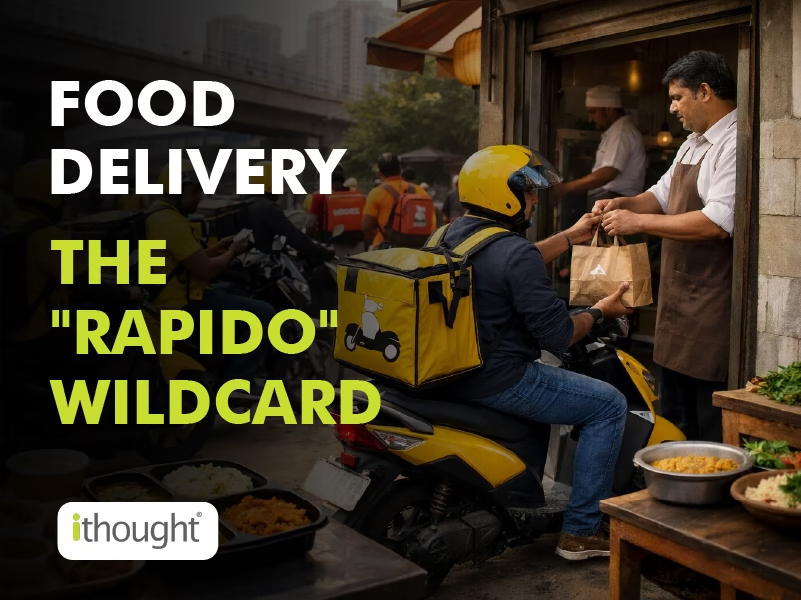
Just when the Swiggy-Eternal duopoly appeared set in stone, Rapido—bolstered by its Ownly partnership—is attempting to disrupt the status quo. The thesis here is rooted in asset optimization: ride-hailing peaks during commute hours, while food delivery peaks during lunch and dinner. By cross-utilizing the same fleet, Rapido aims to undercut the incumbents on delivery costs. Their focus on lower Average Order Value (AOV) cohorts—the “everyday” meal rather than the “weekend treat”—threatens the volume growth of the leaders. If Ownly remains a lower-commission alternative for restaurants, we may see a significant supply-side shift.
The “Instant Help” Explosion: Snabbit & Urban Company
Convenience is moving beyond the kitchen. Snabbit and Urban Company collectively clocking millions of orders in March 2026 marks a landmark moment for the “instant help” sector. While Urban Company has traditionally dominated high-intent, scheduled services like AC maintenance, it is now pivoting to capture the “impulse” market—such as immediate maid services. This suggests the urban Indian consumer’s “convenience threshold” has dropped further; we now expect a service professional as quickly as we expect a grocery delivery.
Indian consumer’s expectation for speed has expanded from products to people. Whether it is a sourdough loaf, a hot meal, or a professional cleaner, the urban Indian now expects a solution in under 30 minutes. This is a structural change; once a consumer experiences the efficiency of on-demand help, the friction of traditional searching becomes unacceptable.
For investors, the winners are those who can capture this massive shift in consumption while proving that they can save the consumer time and themselves every possible paise.
The Investor Lens
For investors, the opportunity lies in identifying platforms that can capture this massive shift in consumption while simultaneously proving unit-level discipline. The winners will not just deliver speed, they will deliver it profitably, optimizing every rupee while saving every minute for the consumer.
Want to stay ahead of these structural shifts?
At ithought, we decode emerging business models, with solid fundamentals, and identify long-term winners early- so you don’t just follow trends, you invest in them with conviction.
Start investing with us today.